

5/8/2026
PABiH Delegation to the Parliamentary Assembly of the Mediterranean (PAM) participates in the 20th PAM Plenary Session in Budva
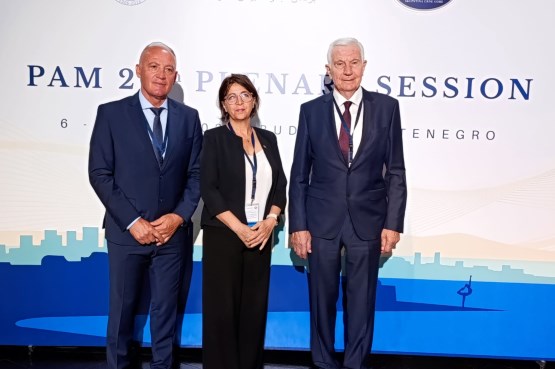
The Chair of the Delegation of the Parliamentary Assembly of Bosnia and Herzegovina (PABiH) to the Parliamentary Assembly of the Mediterranean (PAM), Rejhana Dervišević, and the Deputy Chairs of the Delegation, Sredoje Nović and Vlatko Glavaš, participated in the 20th PAM Plenary Session, which was held in Budva.
Parliamentarians from the member states of this regional multilateral parliamentary organisation, experts, representatives of executive authorities, the academic community, international organisations, and the private and civil sectors discussed the current political, security, and economic situation, as well as the challenges facing the Euro-Mediterranean and Gulf regions. During the session in Budva, discussions also covered global economic conditions caused by the war in the Gulf and the facilitation of regional trade, as well as the issues of human trafficking, migrant smuggling, and the position of children and women in armed conflicts.
As the Rapporteur of the PAM Standing Committee on Economic, Social, and Environmental Cooperation, the Chair of the PABiH Delegation to PAM, Rejhana Dervišević, presented the Report and the Draft Resolution on the topic: "Global Economic Trends and Regional Dynamics in the Euro-Mediterranean and Gulf Regions: Key Outcomes of the Marrakesh IV Agreement."
In her report, Dervišević warned of the fact that the military escalation which began in February this year in the Gulf region has caused a major systemic shock to the energy sector, affecting one of the world's most strategically important economic corridors, the Strait of Hormuz, through which nearly 20 per cent of the global oil supply passes.
According to data from the International Energy Agency, this disruption has created the largest energy crisis in history, with as yet unpredictable consequences for global markets, Dervišević stated. In her capacity as PAM Rapporteur, she expressed concern over the introduction of transit fees by Iran in the Strait of Hormuz, particularly as, she emphasised, countries in other parts of the world might follow suit.
Dervišević further warned that uncertainty in gas supply has intensified, affecting both major producers and import-dependent economies, including several countries in our region.
"The consequences are already visible. Energy markets are becoming increasingly volatile, with sharp fluctuations in oil prices. Simultaneously, supply chains are under growing pressure. Disruptions to maritime routes, combined with limitations in the availability of fertilisers and essential agricultural raw materials, are affecting production cycles. As a result, food price inflation remains persistently high in several parts of the region, in some cases exceeding 10 per cent annually," Dervišević emphasised.
Highlighting the critical role of PAM, Dervišević appealed for urgent action towards coordinated, forward-looking parliamentary and diplomatic responses. She also called for the strengthening of economic cooperation, the promotion of sustainable fiscal frameworks, and the improvement of coordination between the region's economies.
"We must ensure that economic progress remains inclusive by reducing inequalities and providing support to the most vulnerable, especially in fragile environments," Dervišević said.
In the adopted Resolution on this topic, PAM expressed deep concern over the humanitarian and economic consequences of the military conflict in and around the Islamic Republic of Iran, which has triggered the largest energy crisis ever recorded. PAM parliamentarians also warned of the possibility of increased food insecurity across the region caused by the war, including disruptions to supply chains, the flow of fertilisers, and the distribution of minerals and other raw materials. The Resolution called on PAM member states to strengthen dialogue, economic integration, and stability through partnerships in trade, investment, and innovation, and appealed to national parliaments to implement sustainable fiscal policies, including more intensive cooperation with international financial institutions such as the World Bank, the International Monetary Fund, and their parliamentary network.
During the session in Budva, all PAM member states were called upon to adopt inclusive economic policies aimed at reducing poverty and inequality, while strengthening support for the empowerment of women and vulnerable populations, particularly in fragile environments. (end)
|
PRESS
CONTACT |
Public relations department |