

1/28/2026
Delegation of the Parliamentary Assembly of Bosnia and Herzegovina (PABiH) to the Parliamentary Assembly of the Council of Europe (PACE) participated in Strasbourg in the debate on the monitoring report for Bosnia and Herzegovina
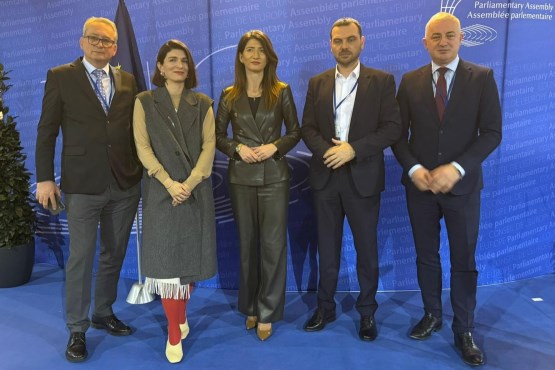
The Chairperson of the PABiH Delegation to the Parliamentary Assembly of the Council of Europe (PACE), Saša Magazinović, the Deputy Chairperson of the Delegation, Darijana Filipović, and Delegation members Branislav Borenović, Sabina Ćudić, and Mladen Bosić participated last night, during the winter session of PACE in Strasbourg, in the plenary debate on the monitoring report for Bosnia and Herzegovina.
The report, titled The functioning of democratic institutions in Bosnia and Herzegovina, was presented by the PACE Monitoring Committee rapporteurs Zsolt Németh from Hungary and Pablo Hispán from Spain. Along with this report, the Monitoring Committee rapporteurs also submitted a draft resolution, which was adopted after the debate, as the document was supported by all political groups in PACE.
In his address to the PACE plenary session, the Chairperson of the PABiH Delegation, Saša Magazinović, thanked the rapporteurs for very clearly emphasizing in the report two extremely important facts that must not be called into question: that the mandate of the High Representative is legitimate and unquestionable, and that state property can and must be managed exclusively by the state of Bosnia and Herzegovina.
Magazinović particularly highlighted that the public broadcasting system in Bosnia and Herzegovina is in the most difficult situation since its establishment—not due to a lack of funds, but because, as he warned, certain political elites are deliberately working to undermine it. In this regard, he called on the Council of Europe to actively engage in resolving this issue.
Magazinović stated that crises in Bosnia and Herzegovina do not occur by accident; rather, they are deliberately produced to conceal forms of brutal crime. He emphasized that at the root of almost all problems and crises in Bosnia and Herzegovina lies crime with a political background. Therefore, in his view, the greatest assistance Bosnia and Herzegovina can receive today is strong, decisive, and consistent support in the fight against crime and corruption.
At the end of his address, Magazinović also warned about violence against women in Bosnia and Herzegovina as a growing and deeply concerning problem. He expressed his expectation that the Council of Europe would step up its engagement in the coming period so that, together—through concrete policies and protection mechanisms—we can put an end to this violence.
In his address to the PACE, member of the BiH PA Delegation, Branislav Borenović, expressed his conviction that Bosnia and Herzegovina can make a major step forward on its European path, regardless of the fact that— as he said—certain ruling political elites have been obstructing the European path and the democratization of our society for years, even decades.
Borenović emphasized that European integration is a process from which citizens have high expectations, particularly when it comes to full freedom of movement and easier flow of goods for the economy in BiH. He pointed out a major problem currently facing the transport community in BiH, namely—what he described as—incredible, unnecessary, and discriminatory restrictions on the work and operations of carriers from BiH and their colleagues from across the Western Balkans region when traveling through European countries.
Borenović expressed his conviction that, through dedicated work on establishing the rule of law and adopting the standards and rules of the European Union—while respecting the constitutional framework and the Dayton Peace Agreement—in BiH it will be possible to close the OHR Office, replace foreign judges in the Constitutional Court of BiH with domestic ones, and fully take over the management of our country through a fair and honest electoral process. This would involve strengthening domestic institutions, especially the judiciary, and creating an environment for a good life for all citizens of BiH.
Due to the limited time for discussion, written contributions were submitted by Darijana Filipović, Deputy Chairperson of the BiH PA Delegation, as well as Delegation members Mladen Bosić and Sabina Ćudić.
The adopted PACE Resolution notes that the legal framework, amended in March 2024 to improve the integrity and transparency of the electoral process, is being gradually implemented. PACE welcomes the fact that these reforms should bring the electoral legislation into line with European standards and, in particular, with the recommendations of the OSCE Office for Democratic Institutions and Human Rights (OSCE/ODIHR), the Group of States against Corruption (GRECO), and the European Commission for Democracy through Law (Venice Commission).
PACE called on the authorities of Republika Srpska to immediately initiate the procedure for appointing judges to the Constitutional Court of Bosnia and Herzegovina, in accordance with the constitutional and relevant legal framework, with the aim of ensuring the full functioning, institutional stability, and effective execution of the Court's constitutional mandate.
PACE recalled the need for constitutional reform in Bosnia and Herzegovina to implement the judgment in “Sejdić and Finci v. Bosnia and Herzegovina.” In that context, PACE welcomed the formation of a working group to prepare amendments to the Constitution of BiH, as well as the draft Law on Amendments to the Election Law of Bosnia and Herzegovina.
In the adopted Resolution, PACE encourages the authorities of Bosnia and Herzegovina to continue cooperation with the Council of Europe, particularly with the Venice Commission, and to make full use of its expertise in the process of electoral and constitutional reform. (end)
|
PRESS
CONTACT |
Public relations department |